
The reform of electronic invoicing will profoundly transform the financial, administrative, and accounting processes of French companies.
But beyond the legal obligation, SMEs — particularly those located between 5 and 30 million euros in revenue — are the most affected.
Why? Because they have:
- of large invoice volumes,
- of structured administrative and financial teams but often under pressure,
- of various tools (ERP + CRM + business software),
- and sometimes heterogeneous internal processes.
For these companies, the reform represents both a major operational risk… and an exceptional opportunity for modernization.
Here’s how to prepare your SME effectively, without disrupting operations.

1. Understand the specific challenges of an SME 5–30 M€
An SME in this revenue range must manage:
✔ hundreds of monthly customer invoices
(ADV, accounting, disputes, reminders)
✔ an equivalent or higher volume on the supplier side
(validation, purchases, budget)
✔ several tools to interconnect
ERP, CRM, supplier portal, BI, accounting…
✔ complex internal workflows at times
multiple levels of validation, cross-functional services, production…
👉 The reform therefore requires rethinking the chain "order → delivery → invoicing → accounting".
2. Step 1: conduct a comprehensive audit of your flows
The first essential step is a compliance and organization audit.
The audit must cover:
🔹 Customer Invoice Flow
- invoice generation
- internal control
- sending (PDF, EDI, platform, etc.)
- disputes and credits
- accounting
🔹 Supplier Invoice Workflow
- receipt emails / portal / ERP
- manual extraction
- expense validation
- accounting integration
Roles & Responsibilities
Who validates? Who sends? Who controls?
→ The reform requires to formalize the roles.
Information system
- ERP (Odoo, Cegid, Sage, SAP B1…)
- CRM or business software
- API connectors
- data flow
Why is it key?
Because electronic invoicing does not require "just a software", but a transformation of the entire flow.
3. Step 2: map your information system
A SME of 5–30M€ generally uses:
- a ERP for management
- a CRM for sales
- a accounting software
- possibly a supplier invoice tool
- a cash management tool
- Excel exports between teams
The reform requires that all these tools know how to communicate via a Certified Platform (PA).
The mapping must answer 3 questions:
ERP, CRM, business software?
Which tool issues the invoices?
Is there a double entry?
What tool accounts for them?
- Customer invoices
- Supplier invoices
- E-reporting
- Credit notes
Which flows will need to go through the PA?
👉 The goal is to identify chain breaks and manual points to automate.
4. Step 3: choose an Approved Platform (AP)
The PA will be the pivot of your entire transition.
A SME must choose its PA based on 6 criteria:
- Compatibility with the existing ERP
- Ability to manage your invoice volume
- Quality of API connectors
- Multi-flow management (e-invoicing + e-reporting)
- Simplicity for teams
- License budget + implementation
Beware of common pitfalls :
- PA chosen too quickly → flows too complex to integrate
- PA not suitable for SME volume → slowdowns
- PA not suitable for internal workflows → massive invoice rejection
- Underestimation of integration costs
Choosing a PA is not a purely technical choice, but an organizational and financial decision.
5. Step 4: interconnect your tools
An SME should aim for the least manual entries possible.
This implies :
- ERP ↔ PA interconnection
- CRM ↔ ERP interconnection
- automation of supplier invoices
- automatic flows to accounting
- compliant archiving
- VAT transmission (e-reporting)
Direct benefits :
- ✔ reduction of errors
- ✔ significant time saving
- ✔ better data reliability
- ✔ immediate integration into financial reporting
6. Step 5: Train and Engage the Teams
Electronic invoicing involves all services :
- ADV
- Accounting
- Finance
- Purchasing
- IT
- Sales management / General management
It is necessary to :
- clarify roles
- explain changes
- train on new formats
- simulate real cases
- plan a cohabitation period (PDF + e-invoicing)
Success relies on 60% on the human factor.
7. Example of an ideal schedule for an SME with a turnover of 5–30M€
2024–mid 2025
Audit, choice of PA, framing of IS
Mid-2025 – end 2025
Interconnections, ERP configuration, initial tests
Beginning 2026
Advanced tests, change management, training
September 2026
Mandatory receipt of electronic invoices
👉 A small and medium-sized enterprise (SME) waiting until 2025 or 2026 will be under total overload, with a risk of non-compliance.
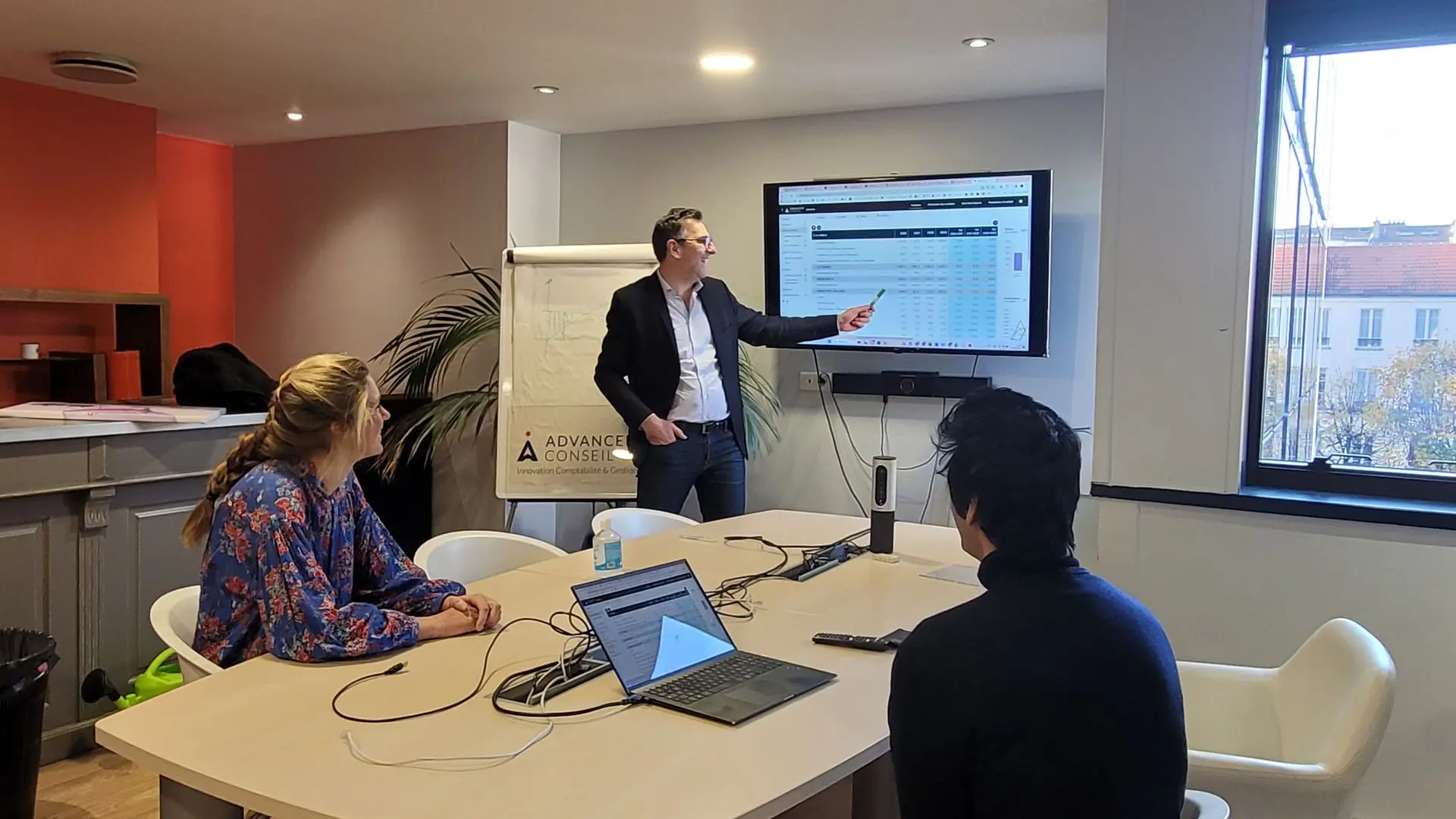
How Advanced Conseil Prepares Your SME
We have designed a comprehensive audit mission specifically for SMEs 5–30M€ :
✔ Audit of flows and processes
✔ Compliance Analysis Reform 2026
✔ Mapping tool & target architecture
✔ Comparison & Recommendation PA
✔ Operational Action Plan
✔ Change management & training
✔ Coordination with your accountant and your ERP
🎯 Full mission < €10,000