
What we often observe in the SMEs we support is a management still very focused on available cash or monthly revenue. Decisions are mainly made based on cash levels, monthly sales, or the manager's feelings, with few indicators truly aligned with the company's overall strategy.
In many organizations, the financial function remains primarily administrative: accounting, invoicing, tax obligations, or basic budget monitoring. However, as the company grows, the stakes evolve rapidly: profitability, resource allocation, margin tracking, investments, recruitment, financing capacity, or risk anticipation.
An SME does not always lack strategy. It often lacks tools to transform that strategy into concrete decisions.
It is precisely for this reason that methods like the Balanced Scorecard make perfect sense in an SME. The goal is not to produce more indicators, but to transform the manager's strategy into concrete, measurable, and truly manageable objectives on a daily basis.
This approach allows for structuring management around several complementary dimensions: financial performance, customer satisfaction, efficiency of internal processes, and the development of skills and organization.
At Advanced Conseil, our outsourced CFOs use this type of tool to help managers move away from purely reactive and short-term management. The challenge is to build a more comprehensive and coherent vision of the company's performance.
What really changes is the ability to align teams around clear and measurable objectives. When employees understand the link between their daily actions and the strategic priorities of the company, management becomes much smoother, more engaging, and effective.
An SME does not always lack strategy. It often lacks tools to transform that strategy into concrete decisions.
In many SMEs, the leader knows their market, customers, and development objectives perfectly. The strategy exists: accelerate growth, improve profitability, recruit, develop a new activity, or structure the company to scale up.
The problem is therefore not always a lack of vision.
The real challenge is often the ability to manage this strategy on a daily basis with reliable indicators and truly actionable data.
Many companies still continue to make their decisions based on:
- late accounting information,
- scattered Excel spreadsheets,
- incomplete indicators,
- or simply the leader's feelings.
This approach can work in a simple structure, but it quickly reaches its limits when the company grows or evolves in a more complex environment.
A strategic management tool precisely allows for linking the leader's vision and the daily operational decisions. The goal is not just to produce more reporting. It is mainly about transforming the company's strategic objectives into concrete indicators that allow for managing:
- profitability,
- cash flow,
- commercial performance,
- productivity,
- investments,
- or even customer satisfaction.
This is the whole point of structured management: to allow the leader to anticipate rather than suffer, and to make decisions with a clear vision of the actual situation of the company.
At Advanced Conseil, we believe that a good management tool should not be reserved for large groups. Thanks to digital tools, ERPs like Odoo, and modern reporting solutions, SMEs can now access much smoother, more responsive, and real-time usable management.
The challenge is not to add complexity.
The goal is to give the leader the means to transform their strategy into concrete and measurable decisions.
Objectives and challenges of the balanced scorecard for strategic management
The goal of a Balanced Scorecard is not to produce another report. It is to translate the strategy into a set of concrete, measurable, and balanced objectives, distributed across several complementary axes.
It is not limited to financial results alone. It allows for the overall management of the company, integrating customer dimensions, internal processes, and long-term development. This is what differentiates it from a simple accounting tracking table.
The operational purposes of a well-constructed management tool:
Align operational actions with the explicitly stated strategy
Assurer un pilotage équilibré entre court terme et vision long terme
Anticipate risks and opportunities before they become crises
Mobilize teams around'shared objectives and measurable
Provide the external or internal CFO with the data to support the leader in a decision-making structured and results-oriented
Before getting started...
✔️ The method Balanced Scorecard structures your strategy into concrete indicators.
✔️ An external CFO helps you deploy it effectively, without burdening your teams.
✔️ It creates a clear dashboard to manage and mobilize the entire company.
The 4 axes of the balanced scorecard as a structure for strategic analysis
The Balanced Scorecard is based on a rigorous framework of strategic planning translated into operational terms. Developed by Robert Kaplan and David Norton, this method is structured around 4 complementary axes:
It allows you to manage the performance of the company in a balanced way, going beyond just financial indicators. Each axis answers a specific strategic question:
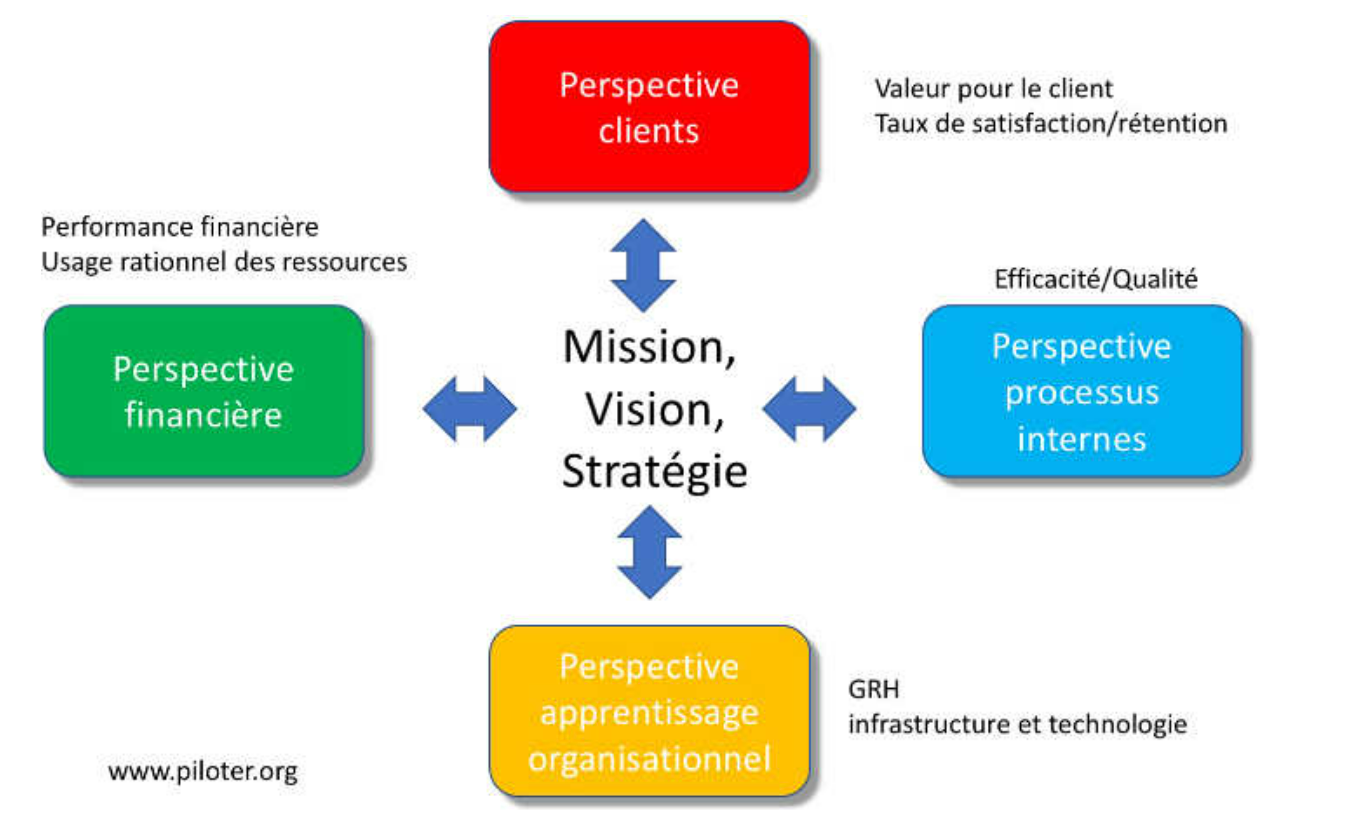
It allows you to manage the performance of the company in a balanced way, going beyond just financial indicators. It is based on four complementary axes :
Financial Axis
What value do we create for our shareholders? What are our long-term financial objectives?
This axis defines the economic goals: revenue growth, profitability improvement, optimization of working capital needs (WCR), cash flow generation.
2. Customer Axis
What do our clients expect from us? What value do we want to create for our clients?
This axis aims to choose the value proposition in which the company will excel: product, price, service, relationship, and image. The concrete levers of action: acquiring new customers, market share, profitability by segments, retaining existing customers, measured customer satisfaction (NPS).
3. Internal Processes Axis
What internal processes must we master to satisfy our shareholders and our customers? What internal levers must we optimize?
This axis identifies the levers of operational efficiency: product innovation, production quality, delivery times, commercial efficiency, after-sales service quality. A well-measured process reveals where time and money are lost.
4. Learning and Innovation Axis
How should the staff learn and enhance their skills to meet these requirements? Which skills need to be strengthened to succeed tomorrow?
This axis reflects the company's ability to progress and adapt: employee skills (training, evaluation), team engagement, innovation capacity, organizational culture.
Each axis is broken down into clear objectives, monitoring indicators (KPI), quantified targets, and action plans. What changes everything: the indicators are not chosen at random, they are directly linked to the company's strategy.
How to implement a steering strategy with the right tools and indicators
Implementation can be quick, provided you have a method adapted to the size and context of the SME :
Clearly define the strategic objectives 2-3 years with management (interviews, workshops)
Translate them concretely onto the 4 axes of the Balanced Scorecard
Select 3 to 5 key indicators per axis (not 30, which would drown the analysis)
Set measurable, realistic, and inspiring targets
Organize regular follow-up (monthly or quarterly) that becomes a management ritual
Automate data collection via a tool (BI, specialized software) to avoid manual updates
What often slows down: wanting too much. An SME does not need 40 KPIs. It needs 12 to 15 relevant indicators that give it real visibility on the health of its business.
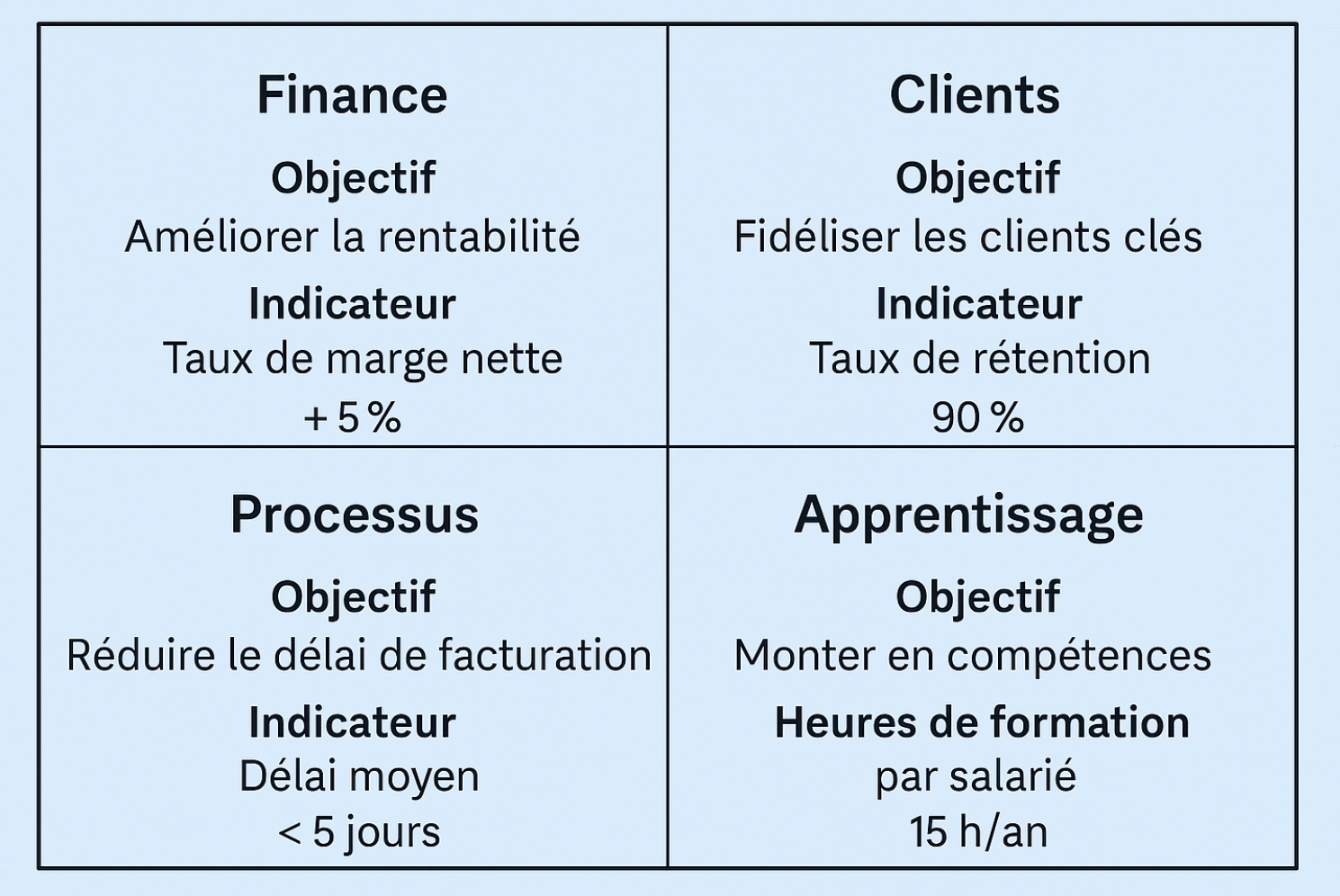
Simplified example: dashboard and strategic indicators for a service SME
Here is a concrete model that you can adapt :
Axis | Objective | Key indicator | Target |
Finance | Improve profitability | Net margin rate | +5 % |
Clients | Retain key clients | Retention rate | 90 % |
Processes | Reduce billing time | Average payment time | < 5 days |
Learning | Skill development | Training hours per employee | 15 h/year |
This table is not exhaustive, it is adaptable. The important thing: that it reflects your real context and that it is updated monthly.
A shared-time outsourced CFO equips SMEs with advanced management tools: monthly reporting, rolling cash forecasts, structured budgets and financial models. Senior expertise immediately available, anticipation of cash needs, optimization of working capital, informed investment decisions.
Quickly implement: the key role of the outsourced CFO
Setting up a forward-looking dashboard requires rigor, but not months of implementation.
We operate in three phases:
Phase 1 – Strategic diagnosis: Audit existing objectives, identify missing indicators, clarify strategy with management
Phase 2 – Dashboard construction: Configure the 4 axes, select the KPIs, integrate existing data (accounting, sales, HR)
Phase 3 – Monthly monitoring: Update indicators, facilitate performance reviews, adjust actions if necessary
This offer combines strategy, shared-time CFO and digital transformation. It provides a senior shared-time CFO, implements automation tools (no-code), integrates ERPs, reporting and electronic invoicing, and structures cash flows with rolling forecasts.
All of this adapts to the key phases of the company: launch, growth, stabilization or revitalization.
Complete with financial planning: forecasting and scenario analysis
A well-constructed dashboard will drive your current results. But to truly anticipate, you need a financial strategy for 24 to 36 months: a forecast that projects your cash needs, your investments, your growth.
This is where the financial forecast complements the operational dashboard. It answers questions like:
Do we have enough cash to fund our projected growth?
What financing needs should we anticipate?
What levers should we act on to improve cash flow?
What is the actual break-even point?
A outsourced financial management integrates this prospective analysis. It transforms past data into future vision, which changes the very nature of decision-making.
Before getting started...
✔️ The method Balanced Scorecard structures your strategy into concrete indicators.
✔️ An external CFO helps you deploy it effectively, without burdening your teams.
✔️ It creates a clear dashboard to manage and mobilize the entire company.
Integrate digital tools: from Excel spreadsheets to real-time dashboards
Many SMEs start with a bulky Excel file. It works for three months, then it becomes a nightmare: multiple versions, forgetfulness, errors, manual updates at 10 PM before the management meeting.
A true management tool must be automated. Data should flow from your actual sources (accounting, CRM, ERP) without re-entry. Ideally in real-time, or at a minimum within 2 days.
We often advise on two complementary axes:
Centralize data: ERP integration (Odoo, Sage), electronic invoicing (Pennylane), bank synchronization
Visualize and analyze: decision-making dashboard, real-time KPIs, automatic alerts
The article that explains how data-driven business management details the steps: define the objectives, audit, centralize and standardize the data, then create strategic management tools (dashboard, BI) that provide a competitive advantage.
The mistakes to avoid in setting up a dashboard
What causes management projects to fail in SMEs:
Too many indicators: 40 KPIs kill the dashboard. Stick to 12-15, aligned with the strategy.
No automation: a manually updated dashboard dies quickly. Invest in data integration.
No ritual: a dashboard without a monthly review does not exist. Create a ritual, otherwise it becomes a dusty object.
Poorly aligned with the strategy: if the indicators do not address your real issues, no one will look at them.
No contextualization: a KPI without an alert threshold does not help. Define green zones (OK), orange (alert), and red (crisis).
Conclusion: transform the finance function into a management lever
The Balanced Scorecard method allows the CFO of an SME to move from reactive short-term management to structured strategic management focused on sustainable performance. It promotes collaboration between departments, improves team alignment, and provides management with a clear and measurable view of strategic progress.
We support leaders and CFOs in implementing this type of tool to transform the finance function into a true management and growth lever. No empty promises: just a proven method, adapted to the realities of SMEs, and active support to make it a management reflex.
Want to structure your management? Make an appointment for a first assessment, with no obligation. We will see together where you stand and what would change if you had a real operational dashboard.
Before getting started...
✔️ The method Balanced Scorecard structures your strategy into concrete indicators.
✔️ An external CFO helps you deploy it effectively, without burdening your teams.
✔️ It creates a clear dashboard to manage and mobilize the entire company.